Business travel pricing is entering a new phase. After years of sharp post-pandemic swings, the picture is surprisingly steadier. However, steadier doesn’t mean cheaper.
That is the headline from the 2027 Global Business Travel Forecast, published by GBTA and ALTOUR with econometric modeling from the Avrio Institute. The report points to elevated costs across air, hotels, ground transportation and meetings in 2026, followed by slower growth in 2027. While demand is holding firm, costs are staying high. The task for travel managers now is to understand how each category is moving, rather than budget off one broad inflation figure.
Despite the macro noise from the fuel crisis and economics in general, the data shows that business travel demand has remained resilient. Across the programs we run, we see companies continuing to view travel as a way to win business, not a discretionary expense to cut first. That resilience underpins the entire forecast: prices are rising because people are still traveling, and suppliers know it.
The forecast draws on the last 18 months of pricing data and projects trends through the remainder of 2026 and into 2027. The spring fare spikes and the fuel shock are reflected in the data, while the full-year 2026 and 2027 figures are modeled projections. The report makes it clear that renewed disruption could push costs even higher.
Air carries the sharpest movements
The sharpest increases this year are seen across flight fares.
What’s changing:
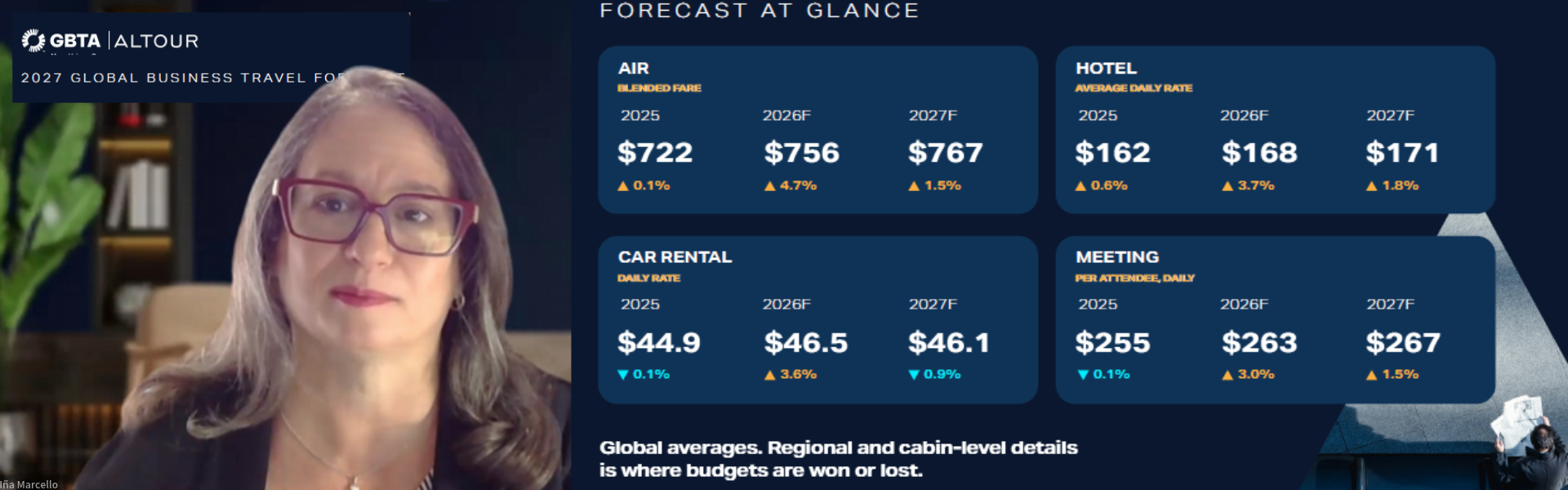
- The average global fare is forecast to rise 4.7% to $756 in 2026.
- Economy fares are projected to increase 8.7% to $536, while premium fares rise 9.5% to $4,488.
- Overall fare growth is expected to slow to about 1.5% in 2027.
- Premium fares in Asia Pacific are forecast to surge 18.6% in 2026, more than double compared to any other region.
The energy crisis has driven much of the rise. Jet fuel peaked at more than $230 a barrel before easing, and fuel now accounts for a larger share of airline costs than it did last year.
The good news is that the pace has slowed. However, two pressures continue to keep prices elevated: an aircraft shortage of roughly 3,170 short against a backlog of nearly 18,100, and the need for approximately 660,000 new pilots by 2044. Neither has a quick solution.
Here is one statistic worth remembering for your next budget conversation. U.S. fares jumped 26.7% in May, yet they remain only 17.3% above 2019 levels, compared with a 30.8% rise in general inflation over the same period. Relative to the wider economy, air travel still represents good value.
There is also evidence that travel policies are working. Fares in both economy and premium cabins rose faster than the blended average, indicating that buyers are trading down. Had the 2025 booking mix remained unchanged, the average fare would have been $787, rather than $756. Managed travel is already helping to maintain costs.
Hotels stay firm, held down by a building boom
Hotels present a more contained outlook.
What’s changing:
- Average daily rates are forecast to rise 3.7% to $168 in 2026, followed by 1.8% in 2027.
- A record construction pipeline is helping keep rates in check: 15,922 projects representing approximately 2.4 million rooms.
- Regional differences remain significant, with rates projected to rise 9.5% in Latin America, but just 0.6% across Europe, the Middle East and Africa.
This influx of new supply is quietly holding rate growth below what demand would otherwise push through. The takeaway is simple: a single global rate assumption will not accurately reflect a regional budget. Plan market by market.
Ground transportation stays the steady line
Car rental continues to be the most predictable category.
What’s changing:
- Daily rates are forecast –to rise 3.6% to $46.50 in 2026 before declining 0.9% in 2027.
- Fleet supply has recovered, and competition is holding prices in check.
Ground transportation offers a reliable baseline for planning with confidence while air and hotel rates continue to fluctuate. The one thing to watch is tariffs, which could increase vehicle costs and place upward pressure on rates in North America and Europe.
Meetings and events: where the budget goes further than it might seem
Meetings operate differently and require their own lens. Demand is rising and budgets are growing, but costs are climbing just as quickly. The additional investment is maintaining quality rather than expanding programs. If your meetings budget went up this year, examine what the extra spend actually delivered.
What’s changing:
- Cost per attendee per day is forecast –to rise 3% to $263 in 2026, followed by 1.5% growth to $267 in 2027.
- Food and beverage costs are rising by mid-to-high single digits, outpacing the 3.5% food-inflation rate.
- Production and labor costs are climbing at a similar pace.
- Incentive travel can cost two to three times more than an internal meeting, with the premium driven by the destination and experience, not just the room rate.
The real insight is where the pressure comes from. The typical meeting isn’t much more expensive – the big, production-heavy events are simply consuming a greater share of the budget. Overall, cost growth is being driven more by event mix and scale than by unit prices.
Group room rates remain relatively contained. The costs inside the ballroom are rising, with food and beverage plus production representing the two biggest lines in most budgets. That makes the case for negotiating the entire event, not just the rooms.
For context, the 2025 Incentive Travel Index puts average incentive spend at $5,100 per person, up 4%, with North American programs averaging closer to $6,000. Buyers are split on 2026: about a quarter plan to reduce spending, while another quarter expect to spend more.
One distinction matters more than any single figure: meetings are the category organizations actually choose. Airfares and room rates must largely be absorbed, but companies control which events to run, at what scale, and with how much production. That makes meetings the largest pool of controllable spend in most programs, and the fastest place to find savings.
What this means for your program
The through-line across every category is the same: this is a period that rewards discipline. Prices remain firm, demand is holding, and the balance of pricing power is shifting back toward buyers only at the margins. A blanket approach will leave value on the table.
What works is a more detailed strategy:
- Break down spend by category, route, destination and event type.
- Set rate strategies region by region rather than relying on global averages.
- Build flexibility into contracts and benchmark often, because both fuel and currency can move quickly.
- Treat the forecast as a directional guide rather than a fixed number, as further disruption could push costs higher.
This is where a travel management company delivers value: turning a set of forecasts into a practical strategy for managing costs, strengthening negotiations and making smarter decisions.