By Cheryl Lamont, Vice President, Marketing & Communications, ALTOUR
Let’s be honest. Corporate travel has a trust problem.
Buyers don’t fully trust pricing.
Travelers don’t trust the experience.
And too many programs rely on policy enforcement rather than genuine engagement.
That was the unspoken backdrop to many of the conversations at this year’s ALTOUR Global Forum in Mexico City.
Because while the industry continues to talk about transformation, most clients are still dealing with the same core issues: fragmented systems, inconsistent delivery, and a disconnect between what’s promised and what actually shows up in the booking experience.
What became clear over the week is this:
The next phase of corporate travel won’t be defined by more technology. It will be defined by how trust is rebuilt. At scale.
Growth Is Easy. Trust at Scale Is Not
There’s no shortage of growth stories in our industry right now. But growth on its own isn’t a differentiator. In many cases, it’s where things start to break.
In his opening remarks, President Gabe Rizzi described ALTOUR as being at a genuine inflection point. Not just in terms of growth, but in how we scale it.
Because scaling a global travel program isn’t just about adding markets or clients. It’s about maintaining consistency. Delivering the same standard, everywhere. Every time.
Mike Boult, Chief Commercial Officer, put it simply: execution is what separates those who grow from those who scale successfully.
And execution, at its core, is a trust issue.
The Myth of the “Global” Program
The industry talks a lot about global capability but many “global” programs are still stitched together. Different experiences by region. Different standards by market. Different levels of accountability depending on where you are in the world.
That’s where trust starts to erode.
What stood out at the forum wasn’t just the growth across regions, it was the level of alignment behind it.
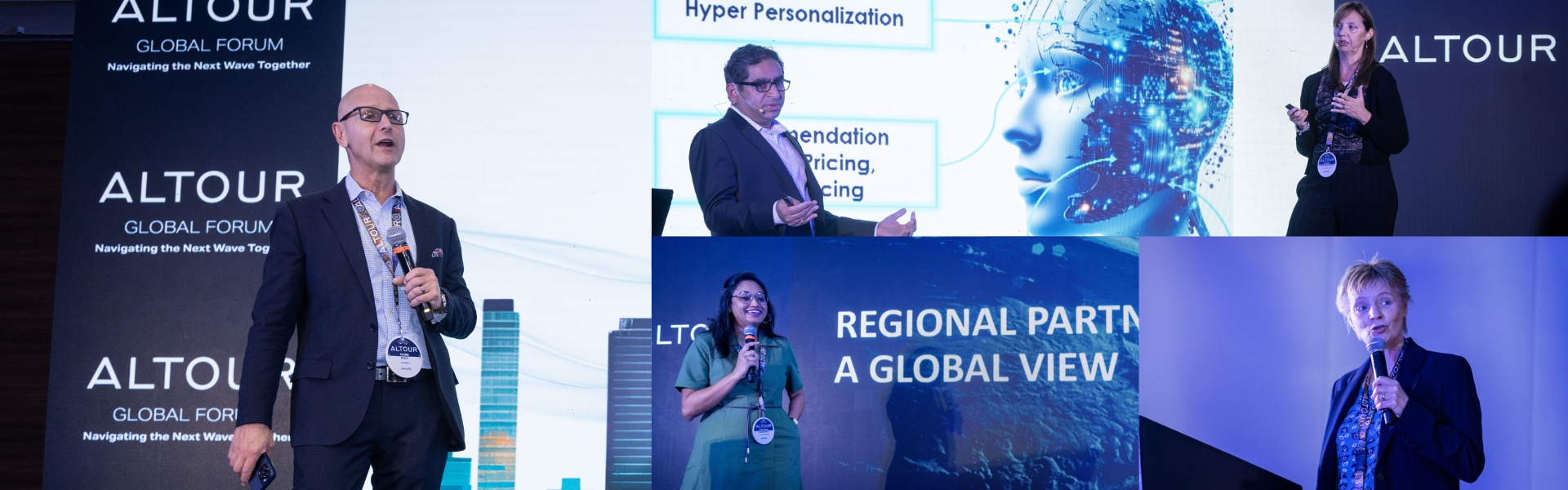
Natasha Padmaraj shared continued momentum across APAC and the Middle East, driven by strong investment and deep local relationships.
Emma Dansie highlighted both the complexity of Europe and the long-term opportunity across Africa.
Carina Grenno pointed to a standout year in Latin America, with significant new business wins and expansion.
Individually, those stories matter. Collectively, they signal something more important: a shift towards operating as one connected global business, not a collection of regional successes.
That’s what clients actually mean when they ask for “global.”
Why Most Travel Programs Still Fall Short
Here’s the uncomfortable truth. Most travel programs don’t fail because of policy.
They fail because of experience.
If the booking experience is clunky, travelers go around it. If the value isn’t visible, compliance drops. If the service isn’t consistent, trust disappears.
Daniel Griffiths, SVP Global Account Management, introduced a more structured global model designed to address exactly that. Not by adding more layers. But by simplifying how clients engage with ALTOUR across markets. Because consistency isn’t just operational. It’s emotional.
Clients need to know what to expect. Every time they interact with us.
Air, Hotel, and the Reality of Supply
The conversations with supplier partners reinforced another industry reality. Demand isn’t the issue.
Peter Vlitas, EVP Partner Relations at Internova, led a panel with Aeromexico, American Airlines, Delta Air Lines, and United Airlines. Across the board, demand for travel remains strong.
The real challenge is how that demand is managed. Through pricing, availability, and increasingly, through smarter use of data and AI.
On the hotel side, Nina Marcello, Sr. Director, ALTOUR Hotel Content & Adoption, led a discussion on RFP dynamics and supply-demand trends across markets including Australia, Brazil, and Canada.
The takeaway was clear. There is value in the system. But unlocking it requires better alignment, stronger program adoption, and a more connected approach across markets.
Again, it comes back to trust. Between clients, suppliers, and the programs designed to connect them.
AI Won’t Fix Broken Trust
AI was everywhere in the conversation. As it should be. But there’s a risk in how our industry is talking about it.
AI isn’t a shortcut to better travel programs. It’s an amplifier.
Sree Pentyala and Matt Jones outlined a future vision built around a unified, interoperable platform supported by agentic workflows.
But technology on its own doesn’t solve inconsistency. It doesn’t fix poor experience. And it doesn’t rebuild trust. People do that.
AI should make travel programs more intuitive. More responsive. More aligned to how people actually travel. But the real value comes from how it’s applied. By teams who understand the client, the traveler, and the moments that matter most.
Recognizing What Good Looks Like
One of the most powerful moments of the week was stepping back to recognize what great execution actually looks like in practice.
- Partner of the Year: ALTOUR Singapore
- Growth Partner 2025: ALTOUR Japan
- Ambassador of the Year: ALTOUR Argentina
These aren’t just awards for performance. They’re a reflection of how that performance is delivered. Consistently. Reliably. In a way that builds trust over time.
We also celebrated 30 years of ALTOUR Mexico, and it’s impossible not to acknowledge the role the team played in making this event what it was.
The welcome, the energy, and the level of support throughout the week set the tone from the start.
It was a reminder that behind every global strategy is a local team making it real.
What Comes Next
Last year’s Global Forum was about bringing the ALTOUR brand together. This year was about raising the standard. Not just for ALTOUR, but for what clients should expect from a travel management partner.
The opportunity ahead isn’t just growth, it’s leadership. Leadership in how programs are designed, how technology is applied and ultimately, how trust is earned back in an industry that needs it.
Because the future of corporate travel won’t be won by those who promise the most. It will be won by those who deliver consistently, transparently and at scale.
And that’s where the real work begins.