
The questions every corporate travel buyer should be asking
Most providers across corporate travel now claim an AI strategy. Far fewer can show what AI actually does, who it protects and where a human still steps in. This guide gives you the questions that separate real capability from theatre, drawn from how ALTOUR runs travel programs at scale.
Why these questions matter now
Every travel technology provider, TMC and supplier now claims an AI strategy. AI in business travel has stopped being a differentiator and become an expectation, which makes your job harder, not easier. The challenge isn’t finding AI. It’s working out whether that AI creates measurable value, protects traveler data and improves the trip itself.
The most important question isn’t whether a supplier uses AI. It’s how they use it, where it runs and what happens when it can’t help.
There’s a fair amount of theatre in the market right now, and that’s likely to continue for a while. As Gabe Rizzi, President of ALTOUR, puts it, the buyer’s job is to look past the polish and pressure-test what’s underneath. This guide gives you the questions to do that, plus the answers that should reassure you and the ones that should give you pause.
“I’ve yet to meet a single AI purveyor that is just plug and play. It all requires some element of development.”— Gabe Rizzi, President, ALTOUR
1. What problem is the AI actually solving?
Many AI demonstrations show off impressive functionality rather than business outcomes. A feature that dazzles in a demo can still leave your program exactly where it started. Start by anchoring the conversation in your problems, not the supplier’s product.
Ask:
- What specific problem does this solve for our program?
- How does it improve the traveler experience?
- How does it reduce program costs, and is that cost cutting or cost avoidance?
- How does it improve operational efficiency, with numbers?
There’s a useful distinction worth pressing here. Cost cutting is easy; it usually just means removing service. Cost avoidance is harder and more valuable. It uses intelligence to stop a cost before it lands, like spotting that the lowest available fare carries triple connections and a high chance of a disruption-driven rebook. Ask which one the AI delivers.
“Sometimes lowest available doesn’t end up being lowest available. Lowest available can actually put you in harm’s way.”— Gabe Rizzi, President, ALTOUR
Red flag: “We have AI” offered as a strategy. The answer should lead with outcomes, not technology.
2. Is this AI running in production, or only in demos?
A demo is a controlled environment. Production is where the real test happens, with messy data, edge cases and live travelers. The gap between the two is where most AI promises quietly fall apart.
Ask:
- How many customers use this in production today?
- What measurable results have they seen, such as resolution rates, time savings or adoption levels?
- Can you share named customer examples or references?
- What adoption levels are you actually seeing day to day?
Adoption is the quiet truth-teller. Plenty of organisations buy AI tools and then barely touch them. If a supplier can show high, sustained usage among their own staff and clients, the tool is doing real work. If they can’t, you’re buying a license, not a capability.
3 . How are you protecting traveler and company data?
Travel programs hold a lot of sensitive information: identity documents, payment details, movement patterns and personal data at scale. AI raises the stakes because data can flow into models and onward to third parties. Governance can’t be bolted on later. It has to sit at the centre.
Ask:
- How is traveler data used by the AI?
- Is our data used to train models, and can we opt out?
- What governance controls exist over how AI makes or shapes decisions?
- How are third-party AI providers vetted before they touch our data?
- What security certifications do you maintain?
There’s a sharper version of this question that’s gaining traction with buyers. If AI is shaping a decision that affects a traveler, do travelers have a right to know? And when something goes wrong, who owns the outcome: the tool, the program or the person who approved its use? A supplier with mature governance will have clear answers. Press for the kind of rigor that feels like a public-company process, because managing personal data at scale demands it.
“We’re managing PII at scale and we need to make sure that the whole notion of trust is at the center of everything we do.”— Gabe Rizzi, President, ALTOUR
Red flag: Vague answers about security or governance, or treating it as a problem for later.
4. How do you vet your AI suppliers?
Most travel providers don’t build their own AI. They partner with specialists and layer their own product on top. That’s a sensible model, but it means your data security is only as strong as their vetting process. You’re trusting a chain, so ask about the chain.
Ask:
- What review process do new AI suppliers go through?
- How often are existing suppliers audited?
- What happens if a supplier changes its data practices after onboarding?
- How do you manage AI risk on an ongoing basis?
A strong partner will admit this process is demanding, and may even mention that suppliers find it frustrating to work through. That friction is a feature, not a bug. It means the tools reaching your travelers have been pressure-tested on your behalf rather than waved through to close a deal.
Worth knowing: A useful litmus test is whether the provider “drinks their own champagne”, meaning they run the same AI internally that they sell to you. If they trust it with their own operation, that tells you something a brochure can’t.
5. Does the AI improve the traveler experience, or just automate processes?
Automation on its own doesn’t create value. It can simply move work around or, worse, benefit the supplier while leaving the traveler exactly where they were. The best AI strips friction out of the journey, so the traveler arrives ready to do the work that justified the trip.
Ask:
- How does this reduce traveler effort, not just supplier effort?
- Does it proactively identify disruption before it hits the traveler?
- Can it improve response times during a live trip?
- Does it help travelers make better decisions in the moment?
Keep the traveler’s real experience in frame. Most travelers picture business travel as dinners and good hotels. They don’t see the friction that leads up to it: the disruption you find out about too late, the meeting that overruns, the rebook that goes sideways.
Good AI attacks that hidden friction. That’s the test.
Red flag: Efficiency gains that only benefit the supplier’s margins, not the traveler’s day.
6. What happens when something goes wrong?
This is where AI conversations get interesting, because travel stays deeply emotional during disruption. Flights get cancelled. Borders close. Weather and geopolitics don’t read the policy. In those moments, travelers rarely want another chatbot. They want reassurance and action.
Ask:
- At what point does human support step in?
- Can a traveler always reach a real person?
- What is the escalation process, and how fast is it?
- How are genuinely complex situations handled?
The honest answer recognizes a hard limit. During the pandemic, technology let people down when travelers sat on four-hour holds with no warm voice on the other end. The same is true now. A chatbot can route a request, but it can’t talk someone down when they’re stranded abroad. When a recent conflict broke out in the Middle East, ALTOUR’s network started moving stuck travelers to safety before head office had even issued guidance, including people who hadn’t booked through them. That’s the difference between a tool and a team.
Key insight: Technology reduces friction. People reduce anxiety. A credible AI strategy is clear about which job belongs to which.
Red flag: An escalation path that loops back to the bot, or a vague promise that “you can always contact us.”
7. Does the AI empower people, or replace them?
The strongest travel programs combine technology and expertise rather than trading one for the other. AI should help consultants, program managers and travelers make better decisions, not quietly thin out the people who hold your program together when it matters.
Ask:
- How are your own employees using AI internally?
- How does AI support your consultants, not just your customers?
- Which decisions stay human-led, and why?
- How does AI improve service quality you can measure?
There’s a sharp line worth quoting back to any supplier. The goal is staff who are enabled by technology, not dependent on it. A consultant with good AI behind them gives faster, better advice. A consultant who can only function through the tool is a risk dressed up as innovation. And a strategy aimed purely at cutting headcount usually costs you on service later.
“Will technology replace people? Maybe not. But people without technology may be replaced by technology.” — Gabe Rizzi, President, ALTOUR
8. Can they explain the AI strategy in plain English?
Complex technology shouldn’t need a complex explanation. If a supplier can’t clearly tell you what AI they use, why they use it and how it creates value for your program, that’s a signal worth heeding. Often it means they’re reselling something they don’t fully understand themselves.
Ask:
- What AI do you use, named and specific?
- Why this approach over the alternatives?
- How does it create value we can see and measure?
Listen for honesty about the build. Credible providers describe themselves as integrators of best-in-class tools rather than developers who invented everything in-house, and they’ll happily tell you which decisions remain human-led. Clarity is the tell. Confidence dressed in jargon usually isn’t.
Red flag: an explanation you need a glossary to follow, or buzzwords standing in for substance.
The future isn’t AI versus human support
One of the biggest misconceptions in business travel, is that you have to choose between technology and people. You don’t. The most effective programs run both, and use each for what it does best.
Set the two side by side and the division of labor gets clear.
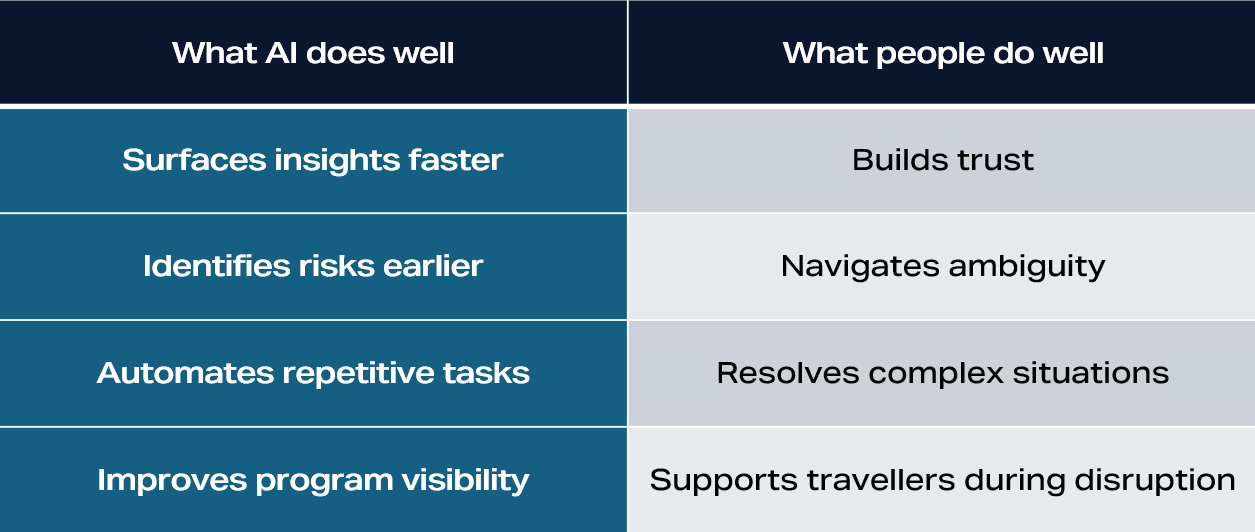
The future of travel management isn’t AI replacing people. It’s people using AI to deliver better outcomes. Use these eight questions to find a partner who understands the difference, and you’ll see straight through the theatre to the providers worth your time.
See how ALTOUR puts these principles to work across global travel programs.